A Step-by-Step Guide to Performing Hajj
Performing Hajj, one of the five pillars of Islam is a profound spiritual journey undertaken by millions of Muslims from around the world each year. This pilgrimage to the holy city of Makkah in Saudi Arabia is a deeply symbolic and physically demanding act of devotion, tracing the footsteps of Prophet Muhammad and commemorating the trials of Prophet Ibrahim (Abraham) and his family. Here’s a step-by-step guide on how to perform Hajj:
- Niyyah:
The concept of Niyyah, or intention, holds immense significance in Islam, especially when embarking on the journey of Hajj. It encapsulates the essence of sincerity, devotion, and spiritual purity, serving as the foundation upon which all acts of worship are built. Before setting foot on the sacred path to Makkah, Muslims are instructed to introspect deeply and make a solemn vow to perform Hajj with unwavering dedication and sincerity, solely for the pleasure and acceptance of Allah.
The intention to perform Hajj must emanate from the depths of the heart, free from any ulterior motives or worldly distractions. It is not merely a verbal declaration but a profound inner resolve that reflects the believer’s profound desire to draw closer to the Divine and seek His forgiveness and mercy. This intention acts as a guiding light throughout the pilgrimage, illuminating the path and infusing every action and ritual with spiritual significance and meaning.
Sincere intention transforms the physical journey of Hajj into a spiritual odyssey, wherein pilgrims embark on a quest for spiritual purification, self-reflection, and divine proximity. It instills a sense of humility and reverence, reminding pilgrims of their inherent vulnerability and dependence upon the grace and mercy of Allah. With each step taken towards the sacred precincts of Makkah, the intention to perform Hajj serves as a constant reminder of the ultimate purpose behind the pilgrimage – to submit wholeheartedly to the will of Allah and seek His pleasure above all else.
The sincerity of one’s intention is not measured by the grandeur of outward displays or the ostentation of words but by the purity of one’s heart and the depth of one’s devotion. It is a deeply personal and intimate commitment between the believer and their Creator, transcending the confines of time and space. The sincerity of intention distinguishes true worship from mere ritualistic observance, infusing every act of worship with spiritual vitality and divine acceptance.
In essence, the Niyyah to perform Hajj is a sacred covenant between the pilgrim and Allah, a solemn pledge to embark on a journey of self-discovery, transformation, and spiritual renewal. It is a testament to the believer’s unwavering faith and devotion, a beacon of light guiding them through the trials and tribulations of the pilgrimage, and ultimately leading them to the fulfillment of their deepest spiritual aspirations.
- Ihram:
The state of Ihram represents a sacred transition for pilgrims embarking on the Hajj journey, marking the commencement of a period of spiritual consecration and devotion. As pilgrims approach the designated boundary known as the miqat, they enter into this revered state, symbolizing their readiness to detach from worldly distractions and immerse themselves fully in the rituals and rites of Hajj.
For men, the attire of Ihram consists of two simple, seamless white garments. The first piece, known as the ‘izar,’ is a waist wrapper that is wrapped around the lower body, covering from the waist down to the ankles. The second piece, called the ‘rida,’ is a shoulder garment that is draped over the upper body, leaving the right shoulder exposed. These garments are devoid of any adornments or stitching, emphasizing the principle of simplicity and equality among all pilgrims, regardless of their social or economic status.
The choice of white garments for Ihram holds deep symbolic significance in Islam. White is associated with purity, cleanliness, and spiritual enlightenment, reflecting the pilgrim’s aspiration to cleanse their heart and souls of impurities and sins. Additionally, the uniform attire of Ihram serves to unify the diverse multitude of pilgrims, transcending differences of nationality, ethnicity, and social background, and fostering a sense of equality and brotherhood among all believers.
For women, the requirements of Ihram differ slightly from men. While they are also encouraged to wear clothing that symbolizes modesty and humility, women have more flexibility in their choice of attire. They are encouraged to wear loose-fitting garments that cover their entire body except for their face and hands, adhering to the principles of modesty prescribed in Islam. The emphasis is on dressing in a manner that minimizes adornment and draws attention away from physical appearance, allowing women to focus solely on the spiritual journey ahead.
Entering into the state of Ihram is not merely a matter of outward appearance but a profound inner transformation. It signifies a commitment to abstain from certain behaviors and actions that are typically permissible outside of the pilgrimage, such as cutting hair, clipping nails, using perfume, and engaging in marital relations. This state of consecration serves as a constant reminder to pilgrims of their sacred purpose and the need for spiritual vigilance and mindfulness throughout the journey.
In essence, the state of Ihram represents a symbolic journey of purification and renewal, wherein pilgrims cast off the trappings of the material world and adorn themselves with garments of piety and devotion. It is a tangible expression of their commitment to submit to the will of Allah and seek His pleasure through the performance of the sacred rites of Hajj.
- Talbiyah:
The recitation of the Talbiyah is a poignant moment for pilgrims during the Hajj journey, serving as a profound declaration of their submission, devotion, and readiness to embark on this sacred pilgrimage. As pilgrims don the garments of Ihram and enter into a state of consecration, the Talbiyah becomes their constant companion, echoing through the valleys and resonating in their hearts, a melodious melody of devotion and surrender to the Divine.
The words of the Talbiyah hold deep significance and carry layers of meaning that encapsulate the essence of the Hajj pilgrimage. “Labbaik Allahumma Labbaik” translates to “Here I am, O Allah, here I am,” signifying the pilgrim’s profound sense of presence and readiness to respond to the call of their Creator. It is a declaration of their willingness to answer the summons of Allah and fulfill their duty as His humble servants.
“Labbaik la sharika laka Labbaik” emphasizes the monotheistic foundation of Islam, affirming that there is no partner or associate worthy of worship besides Allah. It is a declaration of the pilgrim’s unequivocal belief in the Oneness of God and their commitment to worship Him alone, free from any form of polytheism or association of partners with Him.
“Innal-hamda wan-ni’mata laka wal-mulk, la sharika lak” extols the praise, blessings, and sovereignty of Allah, acknowledging His infinite mercy, benevolence, and dominion over all creation. It is a recognition of the pilgrim’s gratitude for the countless blessings bestowed upon them and an affirmation of their unwavering trust in Allah’s providence and guidance.
The Talbiyah serves as a spiritual anchor for pilgrims throughout the Hajj journey, guiding them through the trials and tribulations of the pilgrimage and reminding them of their ultimate purpose – to seek closeness to Allah and attain His pleasure. With each repetition of the Talbiyah, pilgrims reaffirm their commitment to their Creator and renew their resolve to tread the path of righteousness and obedience.
The simplicity and profundity of the Talbiyah encapsulate the essence of the Hajj pilgrimage, reminding pilgrims of their ultimate destination – the pleasure and acceptance of Allah. It is a melody of the soul, sung by millions of voices in unison, echoing through the ages and resonating with the spirit of devotion and surrender that defines the Hajj pilgrimage.
- Departure to Makkah (Tawaf al-Qudum):
The departure to Makkah marks a pivotal moment in the Hajj journey, as pilgrims embark on a sacred pilgrimage to the holiest city in Islam. It is a journey of spiritual significance and profound importance, as pilgrims make their way towards the Kaaba, the sacred House of Allah, with hearts brimming with anticipation and reverence.
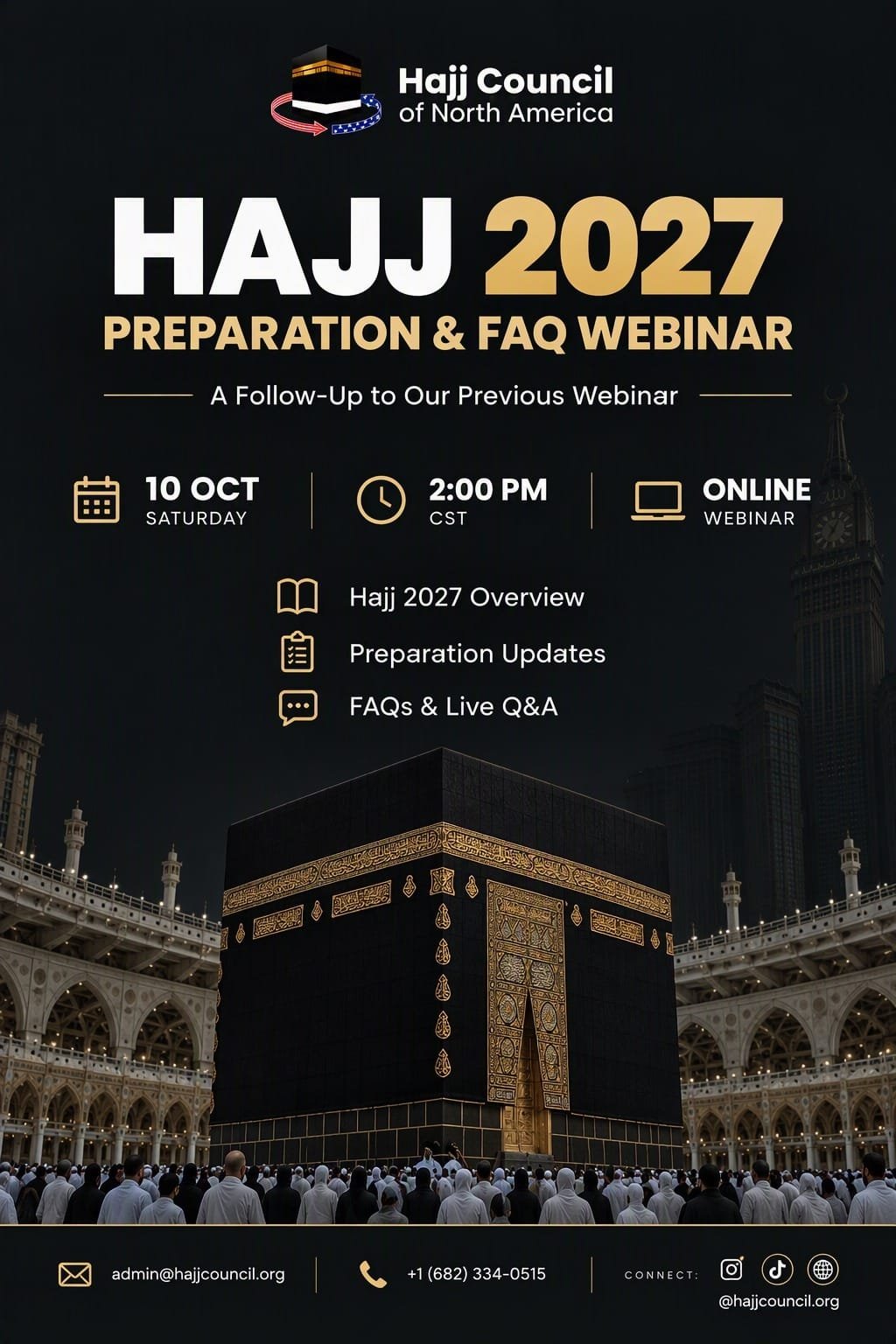
Upon arriving in Makkah, pilgrims are greeted by the sight of the majestic Kaaba, draped in its resplendent black cloth, standing as a symbol of divine unity and spiritual sanctuary. It is a moment of awe and humility as pilgrims stand in the shadow of this sacred structure, humbled by its magnificence and overwhelmed by the sense of divine presence that permeates the air.
The performance of Tawaf al-Qudum, or the Arrival Tawaf, marks the beginning of the pilgrim’s interaction with the Kaaba, as they circumambulate it in a counter-clockwise direction seven times. This ritual is a profound expression of reverence, devotion, and submission to Allah, as pilgrims encircle the Kaaba, casting aside all worldly distractions and focusing their hearts and minds solely on the Divine.
Each circumambulation of the Kaaba during Tawaf al-Qudum is imbued with spiritual significance, as pilgrims offer prayers, supplications, and praises to Allah, seeking His forgiveness, mercy, and guidance. It is a deeply personal and intimate encounter with the Divine, as pilgrims pour out their hearts in devotion, gratitude, and humility before their Creator.
The performance of Tawaf al-Qudum serves as a spiritual initiation for pilgrims, as they symbolically enter into the sacred precincts of Makkah and embark on a journey of spiritual purification and renewal. It is a moment of spiritual rebirth, as pilgrims cast off the burdens of sin and worldly attachments, and set their sights on the eternal rewards promised by Allah for those who undertake the pilgrimage with sincerity and devotion.
As pilgrims complete their Tawaf al-Qudum, they are filled with a sense of awe and reverence, knowing that they have been blessed with the opportunity to stand in the presence of the Kaaba and draw closer to Allah. It is a moment of profound spiritual significance and divine grace, as pilgrims take their first steps on the path of Hajj, guided by the light of faith and illuminated by the blessings of Allah.
- Stay in Makkah:
The stay in Makkah presents pilgrims with the opportunity to engage in additional acts of worship, including the optional Umrah pilgrimage. Umrah, often referred to as the “lesser pilgrimage,” holds immense spiritual significance and serves as a precursor to the main rituals of Hajj. While not obligatory like Hajj, performing Umrah is highly recommended and carries great rewards in the sight of Allah.
The Umrah pilgrimage consists of specific rituals that mirror some of the fundamental acts of Hajj, albeit on a smaller scale. The pilgrimage begins with the performance of Tawaf, the circumambulation around the Kaaba, which serves as a symbolic act of devotion and submission to Allah. As pilgrims circle the Kaaba, they express their reverence and gratitude to the Almighty, beseeching His mercy and forgiveness.
Following Tawaf, pilgrims engage in Sa’i, the walking between the hills of Safa and Marwah. This ritual commemorates the search for water by Hajar (Hagar), the wife of Prophet Ibrahim (Abraham), as she ran between the two hills in search of sustenance for her infant son, Isma’il (Ishmael). Pilgrims traverse the distance between Safa and Marwah seven times, retracing the footsteps of Hajar in a gesture of solidarity and remembrance.
The performance of Umrah holds profound spiritual significance for pilgrims, offering them the opportunity to cleanse their hearts and souls, seek forgiveness for their sins, and draw closer to Allah. It is a journey of self-reflection, renewal, and spiritual rejuvenation, as pilgrims immerse themselves in acts of worship and devotion.
Moreover, performing Umrah before Hajj serves to prepare pilgrims physically, mentally, and spiritually for the rigors of the main pilgrimage. It allows them to acclimate to the sacred environment of Makkah, familiarize themselves with the rituals of Tawaf and Sa’i, and cultivate a deeper connection with the Kaaba and its surroundings.
The optional nature of Umrah underscores the generosity and mercy of Allah, who rewards His servants for their voluntary acts of worship. Pilgrims who choose to perform Umrah alongside their Hajj pilgrimage demonstrate their eagerness to multiply their spiritual rewards and seize every opportunity to draw closer to their Creator.
- Mina:
Mina holds a significant place in the hearts of pilgrims undertaking the Hajj journey. Located approximately 5 kilometers east of Makkah, this tent city becomes a bustling hub of spiritual activity as pilgrims converge here on the 8th of Dhul-Hijjah, marking the beginning of the Hajj rituals.
As pilgrims arrive in Mina, they are greeted by rows upon rows of white tents, which serve as temporary accommodations during their stay. These tents symbolize the unity and equality of all pilgrims, as they come together from diverse backgrounds and walks of life to fulfill their sacred obligation to Allah.
The day and night spent in Mina are dedicated to acts of worship, prayer, and reflection as pilgrims prepare themselves for the profound spiritual experiences that lie ahead. It is a time of introspection and self-assessment, as pilgrims contemplate the significance of their journey and the lessons they hope to glean from it.
In Mina, pilgrims engage in various religious practices, including the recitation of Quranic verses, the performance of voluntary prayers, and the remembrance of Allah through dhikr (recitation of divine names and phrases). Many pilgrims also take advantage of the opportunity to seek forgiveness for past sins and make supplications for guidance, mercy, and blessings from Allah.
Furthermore, the day and night spent in Mina allow pilgrims to form bonds of brotherhood and sisterhood with their fellow believers, as they share meals, stories, and prayers. The sense of camaraderie and solidarity that permeates the atmosphere in Mina reinforces the notion of the global Muslim community as one united Ummah, bound together by a shared faith and purpose.
As the sun sets over Mina and darkness descends, the anticipation and excitement among pilgrims reach a crescendo, knowing that the following day will mark their journey to Arafat, the pinnacle of the Hajj pilgrimage. With hearts filled with hope and devotion, pilgrims retire to their tents for a night of rest and contemplation, eagerly awaiting the dawn of a new day and the fulfillment of their sacred duty to Allah.
In essence, Mina serves as a sacred waypoint on the journey of Hajj, where pilgrims pause to recharge their spiritual batteries, seek divine guidance, and strengthen their resolve to fulfill the rites of Hajj with sincerity and devotion. It is a testament to the transformative power of the Hajj pilgrimage, as pilgrims undergo a journey of self-discovery, renewal, and spiritual awakening in the sacred precincts of Mina.
- Arafat:
The Day of Arafat, occurring on the 9th of Dhul-Hijjah, is the focal point of the Hajj pilgrimage, and the plain of Arafat holds profound significance in the hearts of Muslims worldwide. It was here, on this expansive desert plain, that Prophet Muhammad (peace be upon him) delivered his farewell sermon to his followers, outlining the fundamental principles of Islam and imparting his final guidance before his passing.
For pilgrims undertaking the Hajj, the Day of Arafat represents the apex of their spiritual journey. As they gather on the sacred plain of Arafat, they find themselves amidst a sea of humanity, united in their devotion and humility before Allah. The atmosphere is charged with emotion and reverence as pilgrims spend the entire day engaged in acts of worship, supplication, and reflection.
Standing on the plain of Arafat, pilgrims experience a profound sense of closeness to Allah, as they raise their hands in prayer, seeking His mercy, forgiveness, and guidance. It is a day of repentance and renewal, as pilgrims reflect on their past deeds and shortcomings, seeking to purify their hearts and souls before their Creator.
The act of standing on the plain of Arafat is considered the pinnacle of Hajj, symbolizing the culmination of the pilgrim’s journey and their ultimate submission to the will of Allah. It is said that supplications made here are readily accepted by Allah, as pilgrims pour out their hearts in humility and sincerity, beseeching Him for His grace and blessings.
Throughout the day, pilgrims engage in various acts of worship, including recitation of the Quran, remembrance of Allah (dhikr), and voluntary prayers. Many pilgrims also take advantage of the opportunity to seek forgiveness from their fellow believers, reconciling any disputes or grievances and fostering a spirit of unity and brotherhood.
As the sun begins to set on the horizon, signaling the end of the Day of Arafat, pilgrims depart from the plain of Arafat with hearts full of gratitude and hope, knowing that their supplications have been heard by the Most Merciful. It is a day of spiritual transformation and renewal, as pilgrims emerge from Arafat with a renewed sense of faith, devotion, and purpose, ready to embark on the next phase of their journey towards spiritual fulfillment and closeness to Allah.
- Muzdalifah:
After the spiritually charged day at Arafat, pilgrims proceed to Muzdalifah as the sun begins to set, marking the transition to the next phase of the Hajj pilgrimage. Muzdalifah, situated between Arafat and Mina, serves as a sacred resting place for pilgrims, offering them a moment of respite and reflection before the culmination of their Hajj journey.
Upon arrival in Muzdalifah, pilgrims engage in the combined Maghrib (sunset) and Isha (night) prayers, symbolizing their gratitude to Allah for the blessings of the day and their reliance on His guidance and protection for the night ahead. The prayers are performed in congregation, with pilgrims forming rows and standing shoulder to shoulder, emphasizing the unity and solidarity of the Muslim Ummah.
Following the prayers, pilgrims collect pebbles from the surrounding area in preparation for the ritual of Stoning the Devil (Ramy al-Jamarat), which will take place in the coming days in Mina. This symbolic act commemorates Prophet Ibrahim’s rejection of Shaitaan’s temptations and serves as a reminder of the ongoing struggle between good and evil in the hearts of believers.
The collection of pebbles is a tangible reminder of the pilgrim’s commitment to resisting evil and striving for righteousness, as they prepare to cast the stones at the pillars of Jamrat in Mina. It is a moment of spiritual preparation and fortification, as pilgrims steel themselves for the challenges and trials that lie ahead on the remainder of their Hajj journey.
In addition to its ritual significance, Muzdalifah holds a special place in the hearts of pilgrims as a site of spiritual reflection and contemplation. As pilgrims rest under the open sky, surrounded by the vast desert landscape, they are reminded of the transient nature of life and the importance of humility and gratitude before their Creator.
The time spent in Muzdalifah is a poignant reminder of the simplicity and humility that characterizes the Hajj pilgrimage, as pilgrims temporarily set aside the comforts and distractions of the material world to focus on their spiritual journey. It is a moment of spiritual rejuvenation and renewal, as pilgrims draw inspiration from the collective spirit of devotion and unity that permeates the atmosphere in Muzdalifah, ready to continue their journey towards spiritual fulfillment and closeness to Allah.
- Stoning the Devil (Ramy al-Jamarat):
Stoning the Devil, known as Ramy al-Jamarat, is a symbolic ritual performed by pilgrims during the Hajj pilgrimage on the 10th, 11th, and 12th of Dhul-Hijjah in the city of Mina. This ritual commemorates the story of Prophet Ibrahim’s rejection of Shaitaan’s temptations and serves as a powerful symbol of the believer’s steadfastness in resisting evil and upholding faith.
The ritual involves pelting each of the three stone pillars, known as Jamarat, with seven pebbles. These pillars represent the locations where Shaitaan attempted to dissuade Prophet Ibrahim from obeying Allah’s command to sacrifice his son, Isma’il (Ishmael). However, each time Shaitaan appeared, Prophet Ibrahim pelted him with stones, driving him away and affirming his unwavering commitment to Allah.
By performing the act of Stoning the Devil, pilgrims symbolically emulate Prophet Ibrahim’s defiance of Shaitaan’s temptations and reaffirm their commitment to righteousness and obedience to Allah. It serves as a powerful reminder of the ongoing struggle between good and evil in the hearts of believers and the need to continuously strive for spiritual purity and steadfastness in faith.
The act of pelting the pillars with stones is not an act of aggression but rather a symbolic gesture of rejecting evil and purifying oneself from sin. It is a physical manifestation of the believer’s resolve to cast aside worldly temptations and distractions and remain steadfast on the path of righteousness.
Moreover, Stoning the Devil fosters a sense of unity and solidarity among pilgrims, as they come together to perform this sacred ritual in unison. Regardless of nationality, ethnicity, or social status, all pilgrims stand as equals before Allah, united in their commitment to resisting evil and upholding the principles of faith and righteousness.
Through the ritual of Stoning the Devil, pilgrims reaffirm their dedication to the teachings of Islam and their resolve to lead a life guided by the principles of piety, humility, and compassion. It is a transformative experience that leaves a lasting impact on the hearts and souls of pilgrims, instilling in them a renewed sense of faith and spiritual fulfillment as they continue their journey toward closeness to Allah.
- Animal Sacrifice (Qurbani):
After completing the stoning ritual, which is part of the Hajj pilgrimage, Muslims around the world celebrate Eid al-Adha, also known as the Festival of Sacrifice. This festival commemorates the obedience and faithfulness of the Prophet Ibrahim (Abraham) to Allah’s command. According to Islamic tradition, Ibrahim was commanded by Allah in a dream to sacrifice his son, Isma’il (Ishmael), as a test of his faith.
Ibrahim, in his obedience, was about to sacrifice his son when Allah intervened, providing a ram to sacrifice instead. This act symbolizes Ibrahim’s willingness to sacrifice what is dear to him for the sake of Allah. Therefore, during Eid al-Adha, Muslims commemorate Ibrahim’s obedience and Allah’s mercy by sacrificing an animal and distributing its meat to family, friends, and the less fortunate.
The sacrificed animal, often a sheep, goat, cow, or camel, should meet certain criteria, including being of a certain age and in good health. The meat is divided into three parts: one-third is given to the needy, one-third is shared with relatives and friends, and the remaining third is kept for the household.
The act of sacrificing an animal during Eid al-Adha is considered an important religious duty for Muslims who can afford it. It is seen as a symbol of obedience, gratitude, and willingness to make sacrifices for the sake of Allah. It also serves as a reminder of the importance of sharing and caring for the less fortunate in society.
- Haircut (Halq or Taqsir):
The act of having one’s hair clipped or shaved, known as Halq or Taqsir, is a significant ritual performed by pilgrims following the sacrifice during the Hajj pilgrimage. This act holds deep symbolic meaning and serves as a tangible expression of purity, humility, and spiritual renewal.
For many pilgrims, particularly men, the cutting or shaving of hair represents a symbolic shedding of worldly attachments and sins. It symbolizes the casting away of impurities and the embrace of a new, purified state of being. By relinquishing their hair, pilgrims metaphorically rid themselves of any burdens or distractions that may have accumulated over time, allowing them to approach Allah with hearts cleansed and souls rejuvenated.
Furthermore, the act of hair removal during Hajj underscores the principle of humility and equality among all believers. Regardless of their social status or background, all pilgrims partake in this ritual, demonstrating their willingness to submit to the will of Allah and embrace a state of spiritual humility. In the eyes of Allah, all believers stand as equals, united in their devotion and submission to Him.
Moreover, the act of cutting or shaving one’s hair serves as a tangible reminder of the sacrifices made during the pilgrimage. Just as Prophet Ibrahim (Abraham) was willing to sacrifice his son Isma’il (Ishmael) in obedience to Allah’s command, pilgrims commemorate this act of devotion by offering their sacrifices and demonstrating their unwavering commitment to Allah.
The choice between Halq (complete shaving of the head) and Taqsir (trimming or shortening of the hair) is left to the discretion of the pilgrim, with both actions carrying equal merit in the eyes of Allah. Some pilgrims opt for Halq as a symbol of complete surrender and devotion, while others choose Taqsir as a more modest expression of humility and piety.
Regardless of the method chosen, the act of cutting or shaving one’s hair during Hajj signifies a profound spiritual transformation and renewal. It marks the culmination of the pilgrimage experience, as pilgrims emerge from the sacred precincts of Makkah with hearts purified and souls uplifted, ready to embark on a new chapter of their spiritual journey with renewed faith, humility, and devotion to Allah.
- Tawaf al-Ifadah (Tawaf al-Ziyarah):
Tawaf al-Ifadah, also known as the Tawaf of Hajj or the Greater Tawaf, marks a significant milestone in the Hajj pilgrimage, signifying the completion of the main rituals of Hajj. Pilgrims return to Makkah from Mina, where they had performed the ritual of Stoning the Devil, to engage in this sacred act of worship.
Upon reaching Makkah, pilgrims proceed to the Grand Mosque, where the Kaaba stands as the focal point of their devotion and reverence. Tawaf al-Ifadah entails circumambulating the Kaaba seven times in a counter-clockwise direction, just as they did during the initial Tawaf upon arrival in Makkah. However, unlike the first Tawaf, Tawaf al-Ifadah is performed to complete the main rites of Hajj.
The performance of Tawaf al-Ifadah is a deeply spiritual and emotional experience for pilgrims, as they reflect on the significance of their journey and the blessings bestowed upon them by Allah. It is a moment of profound gratitude and humility as pilgrims circle the Kaaba, offering prayers, supplications, and praises to the Almighty, and seeking His forgiveness and mercy.
Following Tawaf al-Ifadah, pilgrims proceed to perform Sa’i between the hills of Safa and Marwah, retracing the footsteps of Hajar (Hagar), the wife of Prophet Ibrahim (Abraham), as she searched for water for her son Isma’il (Ishmael). Sa’i is a symbolic reenactment of Hajar’s unwavering faith and perseverance in the face of adversity, as well as a testament to the power of trust in Allah’s providence.
The completion of Tawaf al-Ifadah and Sa’i signifies the fulfillment of the main rituals of Hajj, marking the culmination of the pilgrim’s spiritual journey. It is a moment of profound significance and accomplishment for pilgrims, as they emerge from the sacred precincts of Makkah with hearts purified and souls uplifted, ready to embark on a new chapter of their spiritual journey with renewed faith and devotion to Allah.
In essence, Tawaf al-Ifadah and Sa’i serve as a spiritual capstone to the Hajj pilgrimage, encapsulating the essence of devotion, submission, and humility before Allah. They symbolize the pilgrim’s profound commitment to their faith and their unwavering determination to seek closeness to Allah through the performance of sacred rituals and acts of worship.
- Return to Mina:
After completing the stoning ritual on the first day of Eid al-Adha, pilgrims participating in the Hajj return to Mina for an additional two to three days. Mina is a tent city located near Makkah, where pilgrims stay in tents during the Hajj.
During their stay in Mina, pilgrims continue to perform the ritual of Stoning the Devil at the three pillars representing Shaitaan. This ritual involves throwing seven pebbles at each of the three pillars, symbolizing the rejection of evil and temptation. This act is a symbolic reenactment of Ibrahim’s stoning of Shaitaan when he was tempted to disobey Allah’s command to sacrifice his son.
In addition to the stoning ritual, pilgrims spend their time in Mina engaged in prayer, reflection, and supplication. They reflect on their journey and the significance of the rituals they have performed. They also pray for forgiveness, guidance, and blessings from Allah.
The time spent in Mina is a period of spiritual contemplation and renewal for pilgrims. It is a time to seek closeness to Allah and to deepen their faith. After their stay in Mina, pilgrims return to Makkah to perform the Tawaf al-Ifadah, the final circumambulation of the Kaaba, before completing the Hajj pilgrimage.
- Farewell Tawaf (Tawaf al-Wida):
Tawaf al-Wida, or the Farewell Tawaf, is the final circumambulation of the Kaaba that pilgrims perform before leaving Makkah. This ritual holds significant spiritual importance for pilgrims as it marks the completion of their Hajj pilgrimage and serves as a farewell to the sacred city.
Before performing Tawaf al-Wida, pilgrims may spend some time in prayer, seeking forgiveness for any shortcomings during their pilgrimage, and reflecting on their journey and experiences. They may also perform Sa’i, walking briskly between the hills of Safa and Marwah, as it is a recommended act to complete the Umrah rituals.
During Tawaf al-Wida, pilgrims circle the Kaaba seven times in a counterclockwise direction, as they did during their arrival at Tawaf. However, this time, they do so with a sense of farewell and gratitude. They supplicate to Allah, asking for acceptance of their pilgrimage and forgiveness for any sins.
After completing Tawaf al-Wida, pilgrims may spend some additional time in Makkah to perform any remaining religious rites, such as additional prayers or visits to other holy sites, before departing for their homes.
Tawaf al-Wida is a poignant moment for pilgrims, as it signifies the end of their spiritual journey and the return to their everyday lives. It is a time of mixed emotions, as pilgrims feel a sense of fulfillment and closeness to Allah, but also sadness at leaving the holy city and the sacred rituals of the Hajj behind.
Throughout the entire pilgrimage, pilgrims strive to maintain a state of spiritual purity, humility, and gratitude, seeking forgiveness for past sins and striving for a renewed sense of faith and closeness to Allah. The journey of Hajj is not merely a physical undertaking but a profound spiritual experience that transforms the hearts and souls of those who embark upon it, fostering a deep sense of unity, brotherhood, and devotion among the global Muslim community.