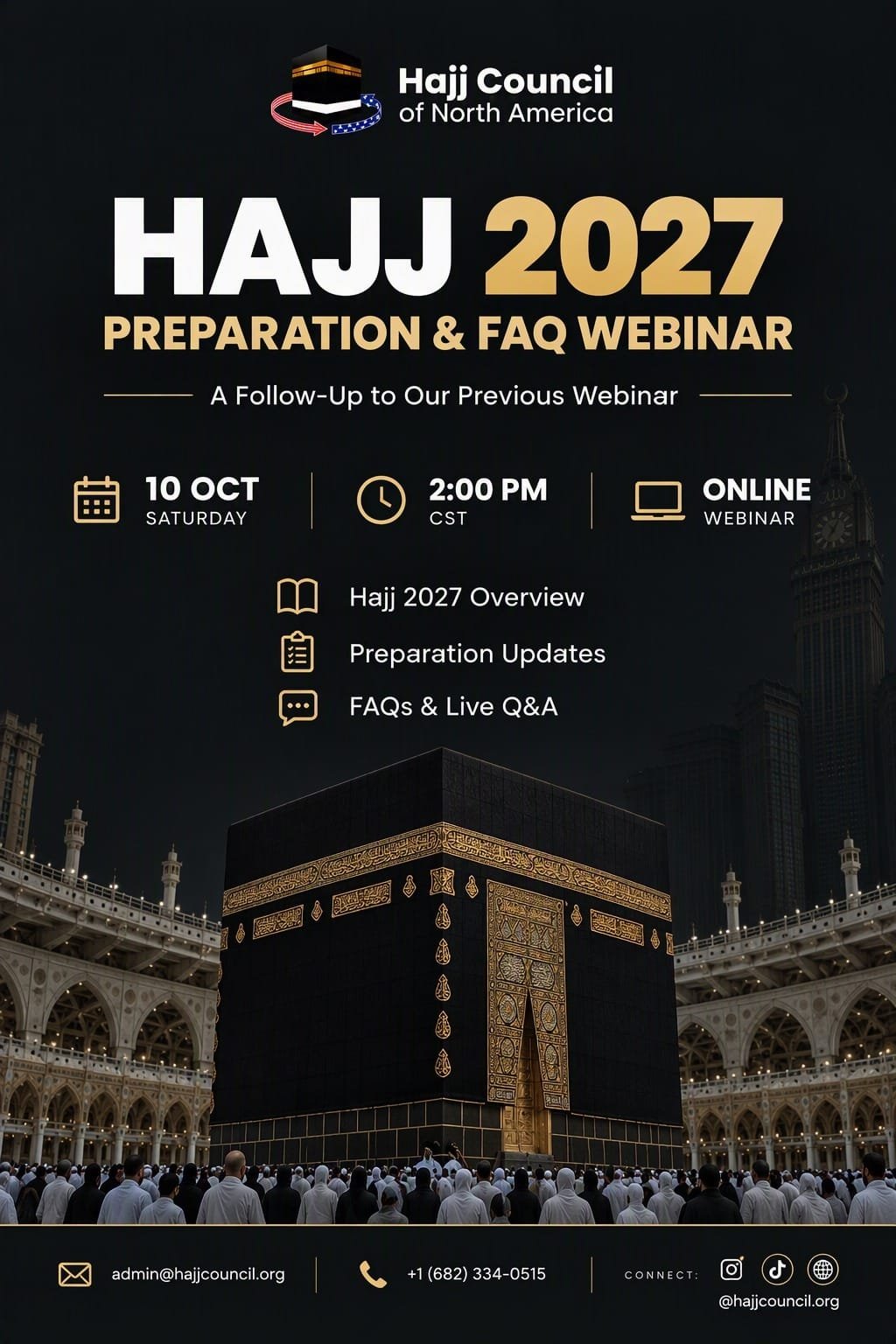
What is Hajj?
Hajj (Arabic: حج), is an annual Islamic pilgrimage to Mecca, Saudi Arabia, the Holiest city for Muslims. It is one of the five pillars of Islam, the others are faith, prayer, fasting, and charity. Hajj being a mandatory religious duty for Muslims, must be undertaken once in a Muslim’s lifetime, providing health and means permit and supporting their family during their absence from home.

Hajj (Definition):
The plural of hajj is hajjes. Hajj is sometimes spelled as haj or hadj. A person who has completed the pilgrimage is called a hajji (or haji or hadji). Hajj is derived from the Arabic verb “Hajja” (Arabic: حَجَّ) meaning, “to make effort” or “to set out to a great place.” From a Shariah perspective, Hajj means “to take oneself to a certain place at a particular time to perform devotional acts as required by Islam.”
Obligations of Hajj:
In the light of Quran. In Quran it is stated in the following verse,
فِيهِ آيَاتٌ بَيِّنَاتٌ مَقَامُ إِبْرَاهِيمَ وَمَنْ دَخَلَهُ كَانَ آمِنًا وَلِلَّهِ عَلَى النَّاسِ حِجُّ الْبَيْتِ مَنِ اسْتَطَاعَ إِلَيْهِ سَبِيلًا وَمَنْ كَفَرَ فَإِنَّ اللَّهَ غَنِيٌّ عَنِ الْعَالَمِينَ
“ In it are clear signs [such as] the standing place of Abraham. And whoever enters it shall be safe. And [due] to Allah from the people is a pilgrimage to the House – for whoever is able to find a way. But whoever disbelieves – then indeed, Allah is free from the need of the worlds.”
Highlighting the obligation of the hajj, this verse also shows that purity of intentions and the ability to undertake the journey are also prerequisites for performing Hajj. The verse also highlights the fact that rejection of the obligation of Hajj is amount to disbelief.
The majority of scholars have the view that Hajj was prescribed in the 6th year after Hijrah with the revelation of the following verse:
وَأَتِمُّوا الْحَجَّ وَالْعُمْرَةَ لِلَّهِ
“And complete the Hajj and Umrah for Allah.”
Other scholars are inclined to the view that Hajj was made obligatory in the ninth or the tenth year of Hijrah.
In the light of Hadith
There are many Hadiths that allude to the obligation of Hajj. Abu Huraira I narrates:
Allah’s Messenger ﷺ addressed us and said:
‘O people, Allah has made Hajj obligatory for you, so perform Hajj.’
Abdullah ibn Abbas I narrates:
A woman from the tribe of Khath’am came in the year (of Hajjat al-Wada of the Prophet ﷺ) and said: ‘O Allah’s Messenger ﷺ! My father has come under Allah’s obligation of performing Hajj, but he is a very old man and cannot sit properly on his mount. Will the obligation be fulfilled if I perform Hajj on his behalf?” The Prophet ﷺ replied in the affirmative.
This narration not only emphasizes the obligation of Hajj but also stresses that if an individual is unable to perform the Hajj himself, he must appoint someone to perform it on his behalf.
History of Hajj
In Islamic tradition, the pilgrimage was introduced during the time of the prophet Ibrahim (Abraham). According to tradition, by God’s command, Abraham left his wife Hajira (Hajar) and his son Ishmael (Ismail) alone in the desert of ancient Mecca with little food and water that they soon used up. Mecca was then an uninhabited place. In search of water, Hajira desperately ran seven times between the two hills of Safa and Marwah but found none. Back in despair to Ishmael, she saw the baby scratching the ground with his leg and a water fountain underneath. Because of the presence of water, tribes started to settle in Mecca, Jurhum being the first such tribe to arrive. When grown up, Ishmael married in the tribe and started living with them. The Quran states that Ibrahim, along with his son Ishmael, raised the foundations of a house that is identified by most commentators as the Kaaba. After the placing of the Black Stone in the Eastern corner of the Kaaba, Ibrahim received a revelation in which Allah told the aged prophet that he should now go and proclaim the pilgrimage to mankind. The Quran refers to these incidents in 2:124-127 and 22:27-30. Islamic scholar Shibli Nomani mentions that the house raised by Abraham was 27 feet high, 96 feet long, and 66 feet wide.

Virtues of Hajj
There are many benefits of performing Hajj.
1. Hajj Removes Sins
The person who goes for Hajj earns the pleasure of his Lord and comes back with all his sins forgiven.
Abu Huraira narrated:
The Prophet (SAW) said “Whoever performs Hajj and does not commit any obscenity and wrongdoing, he, or she, will come out as the day he, or she, was born – pure and sinless.” (Bukhari)
Abdullah ibn Masud I narrates:
The Prophet ﷺ said: ‘Alternate between Hajj and Umrah (regularly), for these two remove poverty and sins just as the blacksmith’s bellows removes all impurities from iron, gold, and silver. There is no reward for an accepted Hajj (Hajj Mabrur) except Paradise.’
The Reward of Hajj Mabrur (Accepted Hajj) is Paradise
The reward of performing Hajj with increased Taqwa (being God-conscious) and to a high standard of perfection, is Paradise.
“A Mabroor Hajj, complete and accepted, has no reward for it but Jannah.” (Muslim)
Abu Huraira reports:
All sins committed between the performance of one Umrah and another are expiated and erased. And there is no reward for a Hajj Mabrur except paradise.
“Hajj Mabrur” and “Hajj Maqbul” are often used interchangeably and translated as ‘accepted’ but there is a subtle difference between the two.
- Hajj Maqbul is a pilgrimage in which all the obligations and requirements are completed without any minor or major expiation. It is a fulfillment of the obligation of Hajj.
- Hajj Mabrur is a pilgrimage that is free of sin and graced with divine acceptance and pleasure.
2. Safeguard from Punishment
Aisha J narrates that the Prophet ﷺ said:
There is no day wherein Allah saves more of his servants from the fire of hell than the Day of Arafat. He draws near and praises them to the angels, saying: ‘What do my servants want?’
3. One of the Best Deeds
Abu Huraira reports:
The Prophet ﷺ was asked:‘What is the best deed?’He replied: ‘To have faith in Allah and His Messenger.’ The enquirer asked: ‘What next?’ The Prophet ﷺ said: ‘To strive in the cause of Allah.’He was then asked: ‘What is the next best thing?’ He replied: ‘To perform Hajj Mabrur’.
4. A Form of Jihad
Aisha reports that she once said:
‘O Prophet of Allah! Jihad (striving or fighting for the cause of Allah) is the best deed. Should we (women) then not actively participate in it?’ The Prophet ﷺ replied: ‘The best Jihad for you is Hajj Mabrur.’9
Abu Huraira I narrates:
Jihad for the elderly, the young, the weak, and women is Hajj and Umrah.
5. Pilgrims are Guests of Allah
Those performing Hajj are guests of Allah (SWT). He is attentive to their needs and listens to their prayers closely.
“The fighter for the Sake of Allah and the one observing the Hajj and ‘Umrah are the guests of Allah; He invited them and they responded, and when they asked Him, He gave them.” (Ibn Maajah)
Abu Huraira I narrates:
The Messenger of Allah ﷺ said: ‘Pilgrims are the guests of Allah; should they supplicate, Allah will answer their supplications; should they seek forgiveness, Allah will forgive them.’
6. Hajj eradicates poverty and sins
Hajj eradicates poverty and sins. Hajj does not eliminate poverty, it instead teaches us to be compassionate towards others and give charity and that is what contributes to reducing poverty.
“Perform Hajj and ‘Umrah successively for they remove poverty and sins just as fire removes the impurities of iron.” (Tirmidhi)
Conditions of Performing Hajj
Hajj is obligated to be performed, by a Muslim, once in a lifetime. One must be;
Muslim:
The pilgrim must be Muslim and must know that performing Hajj is obligatory.
Maturity:
The pilgrim must be mature and have reached puberty i.e. he must be Baligh. All scholars agree that if a minor perform Hajj, the pilgrimage would have to be repeated during adulthood as children aren’t obligated to perform Hajj.
Sanity:
Having physical abilities for performing the acts of Hajj. The pilgrim must be mentally sound and in full control of his mental faculties. Those who are mentally ill aren’t obligated to perform Hajj.
Capability:
Having enough savings to support the cost of living of family members left behind and any other person under the pilgrim’s charge, when the pilgrim goes for Hajj.
Freedom:
Although not applicable in the modern era, the pilgrim must not be a slave.
Safety En-Route:
The journey to Hajj must be deemed safe enough to ensure that the pilgrim’s life and possessions are secure from any danger.
Transport:
The pilgrim must also possess a conveyance and sufficient funds for the journey to Makkah and back.
Immediacy of Hajj
The immediacy of the obligation of Hajj means that it is necessary to take initiative to perform the Hajj in the first year of attaining istita’ah, and failing that at one’s next earliest opportunity…Thereafter, there is no doubt about the sinfulness of the delay if one were to forgo the first opportunity in the case of the absence of another. According to the Shafi’i school, it is not obligatory to perform it as soon as possible and an individual would not be sinful for postponing it. This postponement, however, can only be made under the condition that a firm intention is made to perform the pilgrimage in the future, without the fear of being unable to carry it out.